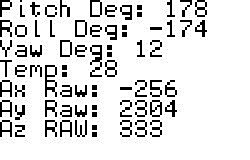
Catcan smartsensor Lite 讀值畫面

本NXC 程式示範了如何用Catcan Smartsensor Lite 來讀取 Roll, Pitch, Yaw三軸向角度。 並附加溫度(攝氏), 以及三軸向的加速度raw值。
Roll, Pitch, Yaw這三個名詞是在航空學中指X, Y, Z軸的旋轉, 見下圖會比較好懂。
NXC程式碼有點長, 有興趣的朋友再慢慢看好了。
============================================
unsigned int tmp=0; //Define temporal return variable
int count = 2;
byte outBuf[], cmdBuf[];
void checkI2C()
{
byte status;
do{
status= I2CCheckStatus(IN_1);
}while(status == STAT_COMM_PENDING);
}
void cali()
{
outBuf[0] = 0x00;
outBuf[1] = 0x00;
ArrayBuild(cmdBuf, 0x30, 0xC0); //Build command array
#if 1
checkI2C(); //Wait I2C bus ready
if ( !I2CBytes(IN_1, cmdBuf, count, outBuf) ) //Send first command and check result
//TextOut(0, LCD_LINE7, "ReadBuf Error"); //Display error if failed
checkI2C(); //Wait I2C bus ready
#endif
}
void setFilterON()
{
outBuf[0] = 0x00;
outBuf[1] = 0x00;
ArrayBuild(cmdBuf, 0x30, 0xf0); //Build command array
#if 1
checkI2C(); //Wait I2C bus ready
if ( !I2CBytes(IN_1, cmdBuf, count, outBuf) ) //Send first command and check result
//TextOut(0, LCD_LINE7, "ReadBuf Error"); //Display error if failed
checkI2C(); //Wait I2C bus ready
#endif
}
void setFilterOFF()
{
outBuf[0] = 0x00;
outBuf[1] = 0x00;
ArrayBuild(cmdBuf, 0x30, 0xf1); //Build command array
#if 1
checkI2C(); //Wait I2C bus ready
if ( !I2CBytes(IN_1, cmdBuf, count, outBuf) ) //Send first command and check result
//TextOut(0, LCD_LINE7, "ReadBuf Error"); //Display error if failed
checkI2C(); //Wait I2C bus ready
#endif
}
//Get Servo Postion
int getPitch()
{
outBuf[0] = 0x00;
outBuf[1] = 0x00;
ArrayBuild(cmdBuf, 0x30, 0x00); //Build command array
checkI2C(); //Wait I2C bus ready
if ( !I2CBytes(IN_1, cmdBuf, count, outBuf) ) //Send first command and check result
//TextOut(0, LCD_LINE7, "ReadBuf Error"); //Display error if failed
checkI2C(); //Wait I2C bus ready
tmp=outBuf[1]; //Parse High Byte
tmp=(tmp<<8)|outBuf[0]; //Parse Low Byte and merge with High Byte
return tmp; //Return Position (type 16Bit int)
}
int getRoll()
{
outBuf[0] = 0x00;
outBuf[1] = 0x00;
ArrayBuild(cmdBuf, 0x30, 0x01); //Build command array
#if 1
checkI2C(); //Wait I2C bus ready
if ( !I2CBytes(IN_1, cmdBuf, count, outBuf) ) //Send first command and check result
// TextOut(0, LCD_LINE7, "ReadBuf Error"); //Display error if failed
checkI2C(); //Wait I2C bus ready
#endif
tmp=outBuf[1]; //Parse High Byte
tmp=(tmp<<8)|outBuf[0]; //Parse Low Byte and merge with High Byte
return tmp; //Return Position (type 16Bit int)
}
int getHeading() //Yaw
{
outBuf[0] = 0x00;
outBuf[1] = 0x00;
ArrayBuild(cmdBuf, 0x30, 0x02); //Build command array
#if 1
checkI2C(); //Wait I2C bus ready
if ( !I2CBytes(IN_1, cmdBuf, count, outBuf) ) //Send first command and check result
//TextOut(0, LCD_LINE7, "ReadBuf Error"); //Display error if failed
checkI2C(); //Wait I2C bus ready
#endif
tmp=outBuf[1]; //Parse High Byte
tmp=(tmp<<8)|outBuf[0]; //Parse Low Byte and merge with High Byte
return tmp; //Return Position (type 16Bit int)
}
int getTemp() //Temp
{
outBuf[0] = 0x00;
outBuf[1] = 0x00;
ArrayBuild(cmdBuf, 0x30, 0x03); //Build command array
#if 1
checkI2C(); //Wait I2C bus ready
if ( !I2CBytes(IN_1, cmdBuf, count, outBuf) ) //Send first command and check result
//TextOut(0, LCD_LINE7, "ReadBuf Error"); //Display error if failed
checkI2C(); //Wait I2C bus ready
#endif
tmp=outBuf[1]; //Parse High Byte
tmp=(tmp<<8)|outBuf[0]; //Parse Low Byte and merge with High Byte
return tmp; //Return Position (type 16Bit int)
}
int getGyro() //Temp
{
outBuf[0] = 0x00;
outBuf[1] = 0x00;
ArrayBuild(cmdBuf, 0x30, 0x04); //Build command array
#if 1
checkI2C(); //Wait I2C bus ready
if ( !I2CBytes(IN_1, cmdBuf, count, outBuf) ) //Send first command and check result
//TextOut(0, LCD_LINE7, "ReadBuf Error"); //Display error if failed
checkI2C(); //Wait I2C bus ready
#endif
tmp=outBuf[1]; //Parse High Byte
tmp=(tmp<<8)|outBuf[0]; //Parse Low Byte and merge with High Byte
return tmp; //Return Position (type 16Bit int)
}
int getAXRaw() //Acelator Raw Data Y
{
outBuf[0] = 0x00;
outBuf[1] = 0x00;
ArrayBuild(cmdBuf, 0x30, 10); //Build command array
#if 1
checkI2C(); //Wait I2C bus ready
if ( !I2CBytes(IN_1, cmdBuf, count, outBuf) ) //Send first command and check result
//TextOut(0, LCD_LINE7, "ReadBuf Error"); //Display error if failed
checkI2C(); //Wait I2C bus ready
#endif
tmp=outBuf[1]; //Parse High Byte
tmp=(tmp<<8)|outBuf[0]; //Parse Low Byte and merge with High Byte
return tmp; //Return Position (type 16Bit int)
}
int getAYRaw() //Acelator Raw Data Y
{
outBuf[0] = 0x00;
outBuf[1] = 0x00;
ArrayBuild(cmdBuf, 0x30, 11); //Build command array
#if 1
checkI2C(); //Wait I2C bus ready
if ( !I2CBytes(IN_1, cmdBuf, count, outBuf) ) //Send first command and check result
//TextOut(0, LCD_LINE7, "ReadBuf Error"); //Display error if failed
checkI2C(); //Wait I2C bus ready
#endif
tmp=outBuf[1]; //Parse High Byte
tmp=(tmp<<8)|outBuf[0]; //Parse Low Byte and merge with High Byte
return tmp; //Return Position (type 16Bit int)
}
int getAZRaw() //Acelator Raw Data Y
{
outBuf[0] = 0x00;
outBuf[1] = 0x00;
ArrayBuild(cmdBuf, 0x30, 12); //Build command array
#if 1
checkI2C(); //Wait I2C bus ready
if ( !I2CBytes(IN_1, cmdBuf, count, outBuf) ) //Send first command and check result
//TextOut(0, LCD_LINE7, "ReadBuf Error"); //Display error if failed
checkI2C(); //Wait I2C bus ready
#endif
tmp=outBuf[1]; //Parse High Byte
tmp=(tmp<<8)|outBuf[0]; //Parse Low Byte and merge with High Byte
return tmp; //Return Position (type 16Bit int)
}
task main()
{
int a = 0, b =0, c =0,t=0;
int axr, ayr, azr, mxr, myr, mzr;
string msg,msg1,msg2,msg3;
SetSensorLowspeed(IN_1); //設定輸出模式為RAW, 9V Lowspeed
//Precedes(get);
ClearScreen();
while(true){
a = getPitch();
Wait(20);
b = getRoll();
Wait(20);
c = getHeading();
Wait(20);
t = getTemp();
Wait(20);
axr = getAXRaw();
Wait(20);
ayr = getAYRaw();
Wait(20);
azr = getAZRaw();
Wait(20);
msg = NumToStr(a);
TextOut(0, LCD_LINE1, " ");
TextOut(0, LCD_LINE1, "Pitch Deg: "+msg);
msg = NumToStr(b);
TextOut(0, LCD_LINE2, " ");
TextOut(0, LCD_LINE2, "Roll Deg: "+msg);
msg = NumToStr(c);
TextOut(0, LCD_LINE3, " ");
TextOut(0, LCD_LINE3, "Yaw Deg: "+msg);
msg = NumToStr(t);
TextOut(0, LCD_LINE4, " ");
TextOut(0, LCD_LINE4, "Temp: "+msg);
Wait(20);
msg = NumToStr(axr);
TextOut(0, LCD_LINE5, " ");
TextOut(0, LCD_LINE5, "Ax Raw: "+msg);
Wait(20);
msg = NumToStr(ayr);
TextOut(0, LCD_LINE6, " ");
TextOut(0, LCD_LINE6, "Ay Raw: "+msg);
Wait(20);
msg = NumToStr(azr);
TextOut(0, LCD_LINE7, " ");
TextOut(0, LCD_LINE7, "Az RAW: "+msg);
Wait(20);
}
}
本文發表於科技趨勢與新知。
留言 💬 (0)
還沒有留言,來當第一個。